
Remnant Seventh Day Adventist Church
Remnant Seventh Day Adventist Church
“And the Lord shall guide thee continually, and satisfy thy soul in drought, and make fat thy bones: and thou shalt be like a watered garden, and like a spring of water, whose waters fail not. And they that shall be of thee (Sabbath keepers) shall build the old waste places: thou shalt raise up the foundations of many generations; and thou shalt be called, The repairer of the breach (4th commandment), The restorer of paths to dwell in.” Isaiah 58:11-12
Jesus Christ has made Seventh-day Adventists the depositaries of His law; He has committed to us sacred and eternal truth, which is to be given to others in faithful warnings, reproofs, and encouragement. We have been chosen by God as a peculiar people, separate from the world. By the great cleaver of truth, He has cut us out from the quarry of the world and brought us into connection with Himself. He has made us His representatives and has called us to be ambassadors for Him in this last work of salvation. The greatest wealth of truth ever entrusted to mortals, the most solemn and fearful warnings ever sent by God to man, have been committed to us to be given to the world.
Seventh-day Adventists have been set in the world as watchmen and light bearers. To us is entrusted the last warning for a perishing world. We have been given a work of the most solemn import—the proclamation of the first, second, and third angels’ message. There is no other work of so great importance. We are to allow nothing else to absorb our attention.
“As many as I love, I rebuke and chasten: be zealous therefore, and repent.” Revelation 3:19
We need in the various departments of the Seventh Day Adventist mission those who are apt to teach; they should be men and women of a tender and meek spirit, like that of Christ, knowing how to help others, whose religion is not the cold, reserved kind, but whose heart is filled with tender sympathy, leading them to help all who need help. Those who are apt to scold, to murmur, to censure should be completely transformed or find work elsewhere. The work of saving men and women does not deal only with their doctrines, but with their whole character. Everything that is harsh in the temperament must be softened down, and everything rough in the manners must be toned down. The truth received with love will, like the leaven, work out its mysterious influence; it has a transforming power; but when you see one pretending to believe the truth remain cold, grumbling, self-sufficient, independent and selfish, you may be assured that the religion of Christ is not practiced in the daily life. Those who are in any way connected with the Seventh Day Adventist mission should form a character after the example of Jesus Christ or else sever your connection with this mission.
The manifestation of a spirit of criticism toward the weaknesses of others, or making evil report of faults which you think you can discern in them, is a matter of sufficient importance for rebuke; and if this evil is not corrected, for church discipline. There are those who have not had an enviable lot in their life. Incessant work and privations have robbed them from the advantages and culture which others have enjoyed. Cases of this kind require the thoughtful interest of all connected with this institution. These individuals should be instructed and trained, but not spoken to bluntly or sharply: this would be cruel. These are the very ones whom Jesus would pity, and whom He will seek to encourage. Those only who are learning in the school of Christ are true instructors. Those who need to learn are the very ones upon whom you should place your attention. High and low, rich and poor, free and bond, all belong to Jesus. Be careful how you honor the most brilliant and despise the humble. We need much more of the presence of Christ and much less of self. Christian courtesy must enter into all the actions of our daily life.
All those who labor in this Seventh Day Adventist mission should endeavor to square their character and influence with the highest ideal, in order to exert by precept and example a healthy, divine influence upon all those with whom you come in contact. Souls are precious; therefore those of us who occupy responsible positions should help others to walk in the right way. Everyone is bound to his fellow men. We are threads in the great web of humanity, and, as such, related with each other. Our life leaves upon the minds of others impressions which will be transferred into all eternity. Angels take note of our works, of our words, and of the spirit which actuates us. Those who desire to reform others must begin the reformation in their own hearts, and show that you have acquired kindliness and humility of heart in the school of Christ. Those who have charge of others must learn first to master yourself, to refrain from blunt expressions and exaggerated censure. There are cutting words which when used will offend, hurt, and leave upon the soul of another a scar which will remain. There are sharp words when used fall as sparks upon an inflammable temper; there are biting words which bite like a viper.
“Judge not, that ye be not judged.” Matthew 7:1.
When fault is found in a brother, or misfortune befalls him, the one in whom true love dwells will not seek to make it public, saying: I told you how it would be; I told you he was not to be depended upon. I worked to disconnect him from that position of influence; for I knew he was not to be trusted. By thus dwelling upon his weakness, you cultivate a spirit of suspicion; you give to your brother no spiritual help, no tenderness, no love. That cold, self-tainted atmosphere is a spiritual malaria; and the erring brother feels in his heart the sentiments that are cherished toward him. He in turn becomes discouraged, loses faith in others, and grows careless and indifferent.
The effort to earn salvation by your own works inevitably leads men to pile up human exactions as a barrier against sin. For, seeing that they fail to keep the law, they devise rules and regulations of their own to force themselves to obey. All this turns the mind away from God to self. His love dies out of your heart, and with it perishes love for others. A church system of human invention, with its multitudinous exactions, will lead its advocates to judge all who come short of their prescribed human standard. This atmosphere of selfish and narrow criticism stifles the noble and generous emotions, and causes men to become self-centered judges and petty spies. The Pharisees were of this class. They came forth from their religious services, not humbled with a sense of their own weakness, not grateful for the great privileges that God had given them. They came forth filled with spiritual pride, and their theme was, “Myself, my feelings, my knowledge, my ways.” Their own attainments became the standard by which they judged others. Putting on the robes of self-dignity, they mounted the judgment seat to criticize and condemn. Many of us partake largely of this Pharisaical spirit, intruding upon the province of conscience and judging one another in matters that lay between the soul and God. It was in reference to this spirit and practice that Jesus said, “Judge not, that ye be not judged.” That is, do not set yourself up as a standard. Do not make your opinions, your views of duty, your interpretations of Scripture, a criterion for others and in your heart condemn them if they do not come up to your ideal. Do not criticize others, conjecturing as to their motives and passing judgment upon them.
We cannot read the heart. Our own selves faulty, we are not qualified to sit in judgment upon others. Finite men judge only from outward appearance. To Him alone who knows the secret springs of every action, and who deals tenderly and compassionately, is it given to decide the case of every soul. “Thou art inexcusable, O man, whosoever thou art that judgest: for wherein thou judgest another, thou condemnest thyself; for thou that judgest doest the same things.” Romans 2:1. Those who condemn or criticize others, proclaim themselves guilty, for you do the same things. In condemning others, you are passing sentence upon yourself, and God declares that this sentence is just. He accepts your own verdict against yourself.
“Why beholdest thou the mote that is in thy brother’s eye?” Matthew 7:3.
Even the sentence, “Thou that judgest doest the same things,” does not reach the magnitude of his sin whosoever presumes to criticize and condemn others. Jesus said, “Why beholdest thou the mote that is in thy brother’s eye, but considerest not the beam that is in thine own eye?” His words describe one who is swift to discern a defect in others. When he thinks he has detected a flaw in the character or the life he is exceedingly zealous in trying to point it out; but Jesus declares that the very trait of character developed in doing this un-Christlike work, is, in comparison with the fault criticized, as a beam in proportion to a mote. It is your own lack of the spirit of forbearance and love for others that leads you to make a world of an atom. Those who have never experienced the contrition of an entire surrender to Jesus do not in their life make manifest the softening influence of His love. They misrepresent the gentle, courteous spirit of the gospel and wound precious souls, for whom Jesus died. According to the figure that our Savior uses, he who indulges a critical spirit is guilty of greater sin than the one you are accusing, for you not only commit the same sin, but add to it conceit and condemnation.
Jesus Christ is the only true standard of character, and he who sets himself up as a standard for others is putting himself in the place of Christ. And since the Father “has committed all judgment unto the Son” (John 5:22), whoever presumes to judge the motives of others is usurping the prerogative of the Son of God. These would-be judges and critics are placing themselves on the side of the Papacy (antichrist), “who opposes and exalts himself above all that is called God, or that is worshiped; so that he as God is sitting in the temple of God, showing himself that he is God.” 2 Thessalonians 2:4.
The sin that leads to the most unhappy results is the cold, critical, unforgiving spirit that characterizes Pharisaism. When your religious experience is devoid of love, Jesus is not there; the sunshine of His presence is not there. No busy activity or Christless zeal can supply the lack. You may have a wonderful keenness of perception to discover the defects of others; but to everyone who indulges this spirit, Jesus says, “Thou hypocrite, first cast out the beam out of thine own eye; and then shalt thou see clearly to cast out the mote out of thy brother’s eye.” He who is guilty of wrong is the first to suspect wrong. By condemning another you are trying to conceal or excuse the evil of your own heart. No sooner had Adam and Eve sinned than they began to accuse each other; and this is what human nature will inevitably do when uncontrolled by the grace of Christ. When men indulge this accusing spirit, they are not satisfied with pointing out what they suppose to be a defect in others. If milder means fail of making him do what they think ought to be done, they will resort to compulsion. Just as far as lies in their power they will force men to comply with their ideas of what is right. This is what the Jews did in the days of Christ and what the church has done ever since (during the Dark Ages) whenever she has lost the grace of Christ. Finding herself destitute of the power of love, Catholicism reached out for the strong arm of the state to enforce her dogmas and execute her decrees. Here is the secret of every religious law that has ever been enacted, and the secret of all persecution from the days of Abel to our own time.
Jesus Christ does not drive but draws men unto Him. The only compulsion which He employs is the constraint of love. When the church begins to seek for the support of secular power (church and state), it is evident that she is devoid of the power of Christ—the constraint of His divine love.
Jesus urges all who have this Pharisaical (Satanic) spirit, first cast the beam out of your own eye, renounce your critical spirit, confess and forsake your own sins, before trying to correct others. For “a good tree brings not forth corrupt fruit; neither does a corrupt tree bring forth good fruit.” Luke 6:43. This accusing spirit which you indulge is evil fruit, and shows that the tree is evil. It is useless for you to build yourselves up in self-righteousness. What you need is a change of heart. You must have this experience before you are fitted to correct others; for “out of the abundance of the heart the mouth speaks.” Matthew 12:34. When a crisis comes in the life of any soul, and you attempt to give counsel or admonition, your words will have only the weight of influence for good that your own example and spirit have gained for you. You must be good before you can do good. You cannot exert an influence that will transform others until your own heart is humbled and refined and made tender by the grace of Christ. When this change is wrought in you, it will be as natural for you to live to bless others as it is for the rosebush to yield its fragrant bloom or the vine its purple clusters.
If Christ is in you “the hope of glory,” you will have NO disposition to watch others, to expose their errors. Instead of seeking to accuse and condemn, it will be your object to help, to bless, and to save. In dealing with those who are in error, you will remember the injunction, Consider “thyself, lest thou also be tempted.” Galatians 6:1. You will call to mind the many times you have erred and how hard it was to find the right way when you once left it. You will not push others into greater darkness, but with a heart full of pity will tell them of their danger. He who looks often upon the cross of Calvary, remembering that it is your sins that placed the Savior there, will never try to estimate the degree of your guilt in comparison with that of others. You will refuse to climb upon the judgment seat to bring accusation against another. There can be no spirit of criticism or self-exaltation on the part of those who walk in the shadow of Calvary’s cross. Not until you feel that you could sacrifice your own self-dignity, and even lay down your life in order to save an erring brother, have you cast the beam out of your own eye so that you are prepared to help others. Then you can approach him and touch his heart. No one has ever been reclaimed from a wrong position by censure and reproach; but many have thus been driven from Jesus and led to seal their hearts against conviction. A tender spirit, a gentle, winning deportment, will save the erring and hide a multitude of sins. The revelation of Jesus Christ in your own character has a transforming power upon all with whom you come in contact. Let Christ be daily made manifest in you, and He will reveal through you the creative energy of His Word—a gentle, persuasive, yet mighty influence to re-create (restore) souls back to His image, the beauty of the Lord our God.
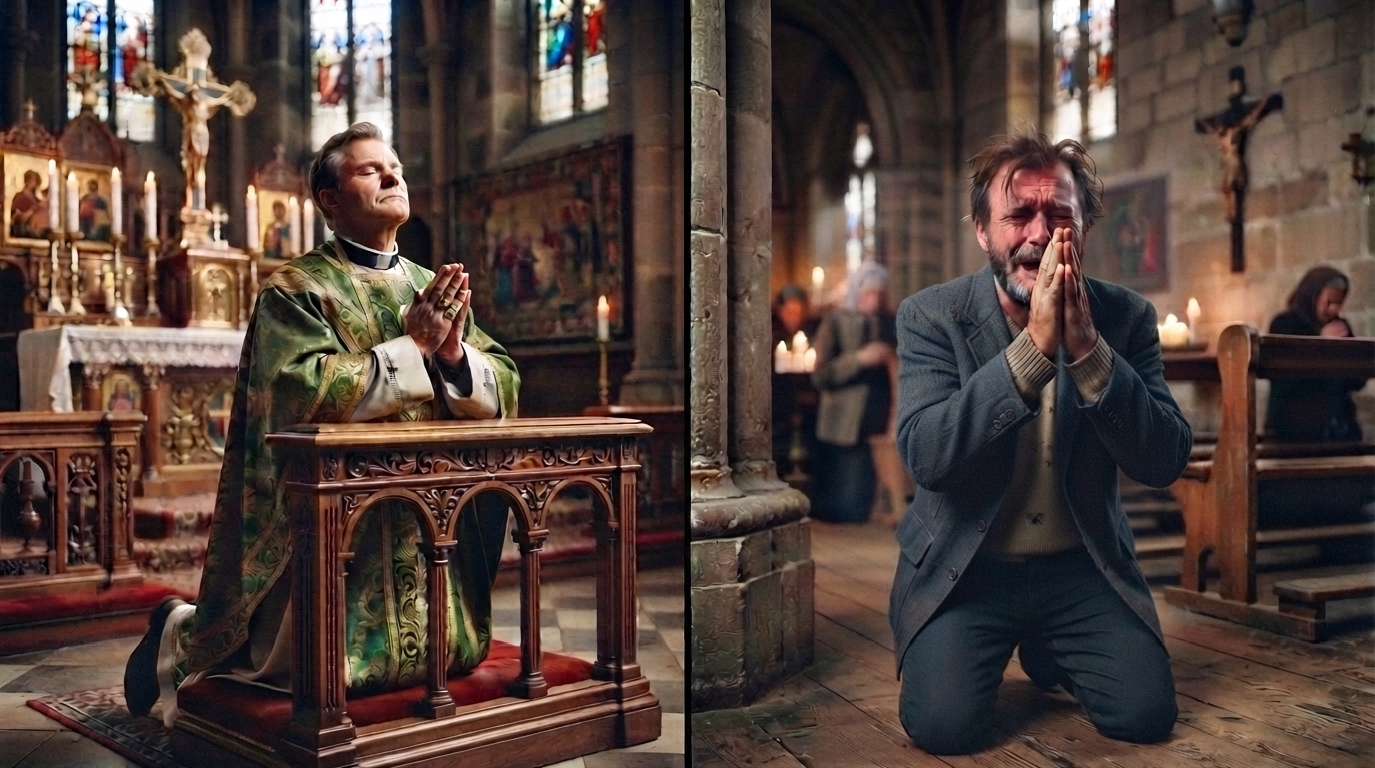
“And he spake this parable unto certain which trusted in themselves that they were righteous, and despised others: Two men went up into the temple to pray; the one a Pharisee, and the other a publican (extortioner). The Pharisee stood and prayed thus with himself, God, I thank thee, that I am not as other men are, extortioners, unjust, adulterers, or even as this publican. I fast twice in the week, I give tithes of all that I possess.
And the publican, standing afar off, would not lift up so much as his eyes unto heaven, but smote upon his breast, saying, God be merciful to me a sinner. I tell you, this man went down to his house justified rather than the other: for every one that exalts himself shall be abased; and he that humbles himself shall be exalted.” Luke 18:9-14

